Parshuram
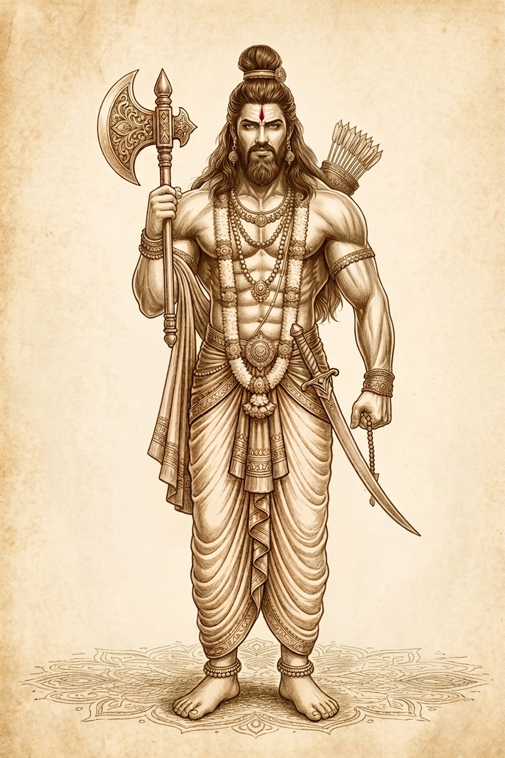
Parshuram is Rama of the Bhargava lineage, the son of Jamadagni and Renuka, and is revered among Vishnu’s avatars. His axe gives him the name by which he is best known. His story moves between the hermitage and the battlefield: the seizure of a sacred cow, the killing of his father, encounters with Rama and the warriors of the Mahabharata, and his return to penance.
Parshuram Ji Mool Mantra
Om Parshuramaaya Namah
Day
Thursday
Color
Saffron
Bhog
Fruits
Choose Reading Section
Select one section and continue your paath in focused reading mode.
Meaning of the Name: Parshuram
Parashurama means “Rama with the axe”. Parashu is the Sanskrit word for axe, distinguishing this avatar from Shri Ram of Ayodhya.
Parshuram Ji: Jamadagni’s Son, the Axe, and the Path of Penance
Parshuram is Rama of the Bhargava lineage, the son of Jamadagni and Renuka, and is revered among Vishnu’s avatars. His axe gives him the name by which he is best known. His story moves between the hermitage and the battlefield: the seizure of a sacred cow, the killing of his father, encounters with Rama and the warriors of the Mahabharata, and his return to penance.
Renuka, Jamadagni, and the Bhargava lineage
Parshuram Ji was born to Sage Jamadagni and Mother Renuka. Sage Jamadagni belonged to the lineage of Sage Bhrigu, while Renuka was a princess of the Ikshvaku dynasty. His original name was Rama, but after receiving a divine axe (Parashu) from Lord Shiva, he became known as Parshuram. He was born on the third day of the bright fortnight of Vaishakha, a day celebrated as Akshaya Tritiya.
From childhood, Parshuram displayed extraordinary talent. He performed severe penance to Lord Shiva and received divine weapons and knowledge from him. Shiva gifted him the divine axe that became his primary weapon. He also studied under Sage Vishwamitra and other sages and became unmatched in the science of archery.
One of the most emotional episodes of Parshuram’s life concerns his mother Renuka. One day, while fetching water from a river, she became momentarily distracted by the sight of the Gandharva king Chitraratha. Sage Jamadagni became angry and ordered his sons to kill their mother. The elder sons refused, but Parshuram obeyed his father’s command and carried out the order.
Jamadagni offers a boon, and Parshuram asks that his mother and brothers be restored to life without remembering the event. The Bhagavata describes their restoration. This difficult sacred narrative involves anger, obedience, and the reversal of death; it should not be reduced to a lesson that violence against a family member is virtuous.
In the Bhagavata Purana, Kartavirya Arjuna takes Jamadagni’s sacred cow by force. Parshuram kills the king and brings the cow back. Jamadagni reproaches his son for killing a ruler and sends him on pilgrimage. Later, in Parshuram’s absence, Kartavirya’s sons kill Jamadagni in revenge. The theft and the murder are separate events with different perpetrators.
After his father’s murder, Parshuram’s campaigns against royal lineages are described as occurring twenty-one times. The accounts reveal the devastating consequences of vengeance as well as conflict over royal power. The story later turns toward gifts, renunciation, and penance. Its depiction of ancient warfare is not a direction to harm any present-day community.
Parshuram’s meeting with Lord Rama is one of the most famous episodes in Hindu tradition. After Rama broke Lord Shiva’s bow in King Janaka’s court, Parshuram arrived in anger and challenged him. However, Rama respectfully revealed his divine nature, and Parshuram recognized him as an incarnation of Vishnu. He then offered his Vishnu bow to Rama and retired to Mount Mahendra for penance.
Parshuram also played an important role during the Mahabharata era. He taught martial arts and warfare to Bhishma, Dronacharya, and Karna. Karna disguised himself as a Brahmin to receive instruction. When Parshuram discovered the deception, he cursed Karna, declaring that he would forget his knowledge at the most critical moment. This story teaches the importance of honesty with one’s teacher.
After conquering the Earth, Parshuram donated all the land he had won to Sage Kashyapa. When Kashyapa requested him to leave that territory, Parshuram used his divine axe to push back the sea and create the land of Kerala. This region became known as Parshuram Kshetra. Even today, people of Kerala and the Konkan coast revere him as the creator of their land.
Parshuram is regarded as immortal and is believed to continue performing penance on Mount Mahendra. It is said that at the end of the current age, he will teach warfare and sacred knowledge to Kalki, the future incarnation of Vishnu. His immortality symbolizes the eternal nature of truth, justice, and righteousness.
Parshuram Ji is not merely an incarnation of Vishnu but also a unique union of Brahmin wisdom and warrior valor. He teaches that standing against injustice and unrighteousness is the highest form of duty, regardless of the strength of the opposition.
The teacher, the axe, and Mahendra mountain
The story of Parshuram Ji teaches that protecting righteousness sometimes requires difficult decisions. He represents sacrifice, devotion to parents, justice, courage, and the defense of dharma. His life demonstrates that power should always be used to uphold righteousness.
Symbol of Justice and Protection of Dharma
Parshuram Ji restored righteousness by defeating arrogant and unrighteous rulers. He teaches that remaining silent in the face of injustice is cowardice and that defending truth is a sacred duty.
Ideal of Obedience to Parents and Teachers
Parshuram faithfully followed his father’s command and later restored his mother’s life. His life highlights the importance of honoring parents and spiritual teachers.
Union of Wisdom and Valor
Though born a Brahmin, he embodied the qualities of a warrior. He mastered both knowledge and combat, teaching that true excellence requires a balance of wisdom and strength.
Supreme Example of Charity and Renunciation
After conquering the Earth, he donated it entirely to Sage Kashyapa and chose a life of austerity. This demonstrates that greatness lies not in possession but in generosity and sacrifice.
Immortality and the Eternal Nature of Dharma
As one of the seven Chiranjeevis, Parshuram symbolizes the enduring power of truth and righteousness. Dharma never perishes, and its defenders remain immortal in spirit.
Preserver of the Guru–Disciple Tradition
He trained great warriors such as Bhishma, Drona, and Karna. His life emphasizes that imparting knowledge is among the greatest acts of service, but honesty and integrity are equally essential.
Balance Between Anger and Self-Control
Parshuram possessed immense anger, yet it was directed against injustice rather than personal gain. He teaches that righteous anger can become a force for good, while selfish anger leads to destruction.
Significance of Akshaya Tritiya and Parshuram Jayanti
Parshuram Jayanti is celebrated on the third day of the bright half of Vaishakha, the same day as Akshaya Tritiya. Acts of charity, prayer, and worship performed on this day are believed to bring everlasting merit.
Creator of Parshuram Kshetra
By pushing back the sea with his divine axe, Parshuram is said to have created the lands of Kerala and the Konkan region. This highlights his role as both a warrior and a creator.
Future Teacher of Kalki
Tradition holds that Parshuram will become the teacher of Kalki, the future incarnation of Vishnu. This symbolizes the continuity of divine wisdom and the eternal mission of protecting righteousness.
Parshuram Ji is an unparalleled symbol of devotion to parents, protection of righteousness, sacrifice, courage, justice, and the harmonious union of knowledge and strength. His story teaches that those who walk the path of truth, righteousness, and justice are honored across the ages. His life demonstrates that standing fearlessly against injustice is among the highest forms of devotion and duty. Immortal and ever-vigilant, Parshuram remains a timeless guardian of dharma. Victory to Parshuram! Victory to Bhargava! Victory to the son of Jamadagni!
Choose Reading Section
Select one section and continue your paath in focused reading mode.