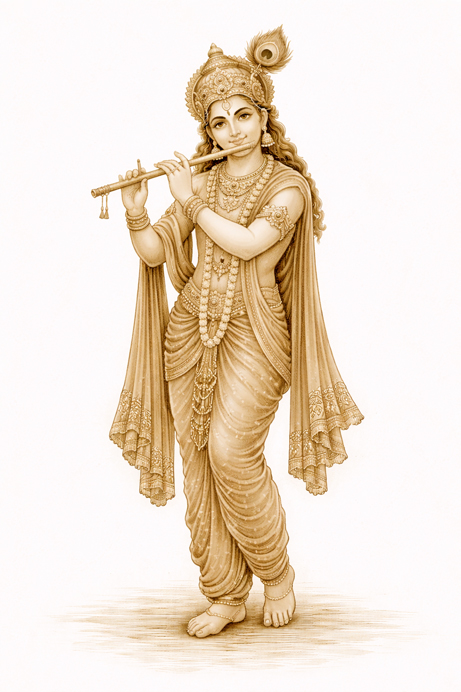
Krishna Ji
Shri Krishna was born to Devaki and Vasudeva in Mathura, where Kamsa had imprisoned them. Fearing the prophecy that Devaki’s child would end his rule, Kamsa had persecuted the family. On the night of Krishna’s birth, Vasudeva carried the child across the Yamuna to the home of Nanda and Yashoda in Gokul.
Krishna Mantra
Om Krishnaya Vasudevaya Haraye Paramatmane Pranata Klesha Nashaya Govindaya Namo Namah
Day
Thursday
Color
Blue
Bhog
Makhan Mishri
Festivals
Janmashtami
Gita Jayanti
Choose Reading Section
Select one section and continue your paath in focused reading mode.
Meaning of the Name: Krishna Ji
Krishna means “dark” or “dark-complexioned” in Sanskrit, much like the Hindi word Shyam. Devotees also understand his name as “the one who attracts everyone”, a meaning drawn from the tradition of bhakti.
Krishna Ji: From Mathura and Vraja to the Teaching at Kurukshetra
Shri Krishna was born to Devaki and Vasudeva in Mathura, where Kamsa had imprisoned them. Fearing the prophecy that Devaki’s child would end his rule, Kamsa had persecuted the family. On the night of Krishna’s birth, Vasudeva carried the child across the Yamuna to the home of Nanda and Yashoda in Gokul.
The beloved child of Vraja
Krishna grew up in Yashoda’s care alongside Balarama. The Bhagavata Purana tells of his childhood play, butter stealing and protection of the cowherd community. He overcame Putana and other dangers, subdued Kaliya in the Yamuna and sheltered the people and cattle beneath Govardhan when Indra sent fierce rain. His flute and his bond with the gopis became central to the devotion of Vraja; Radha’s place is especially developed in later Vaishnava traditions.
One day Yashoda tried to tie the mischievous child to a mortar. Each length of rope fell short, however much she added. Only when Krishna saw her weariness did he allow her to bind him. The Damodara story places the immeasurable Lord within a mother’s reach. Another household episode has Yashoda seeing the universe within his mouth after a complaint that he had eaten earth. Yet the wonder does not take away her loving concern for her son.
Govardhan expands that circle of care to the whole village. Krishna asked the cowherds to honour the hill, the cattle and the life that sustained them. When the storm came, families gathered with their animals beneath the lifted mountain. The Bhagavata describes seven days of shelter. Afterwards Indra approached in repentance. The episode ends with a restored relationship and the honouring of Krishna as Govinda, rather than with rain alone coming to an end.
Mathura and Dwaraka
Krishna and Balarama later went to Mathura, where Krishna defeated Kamsa and freed his parents. His responsibilities widened from the cowherd village to the Yadava community. Dwaraka became his home, and the accounts of his marriage to Rukmini and other queens belong to this phase of his life.
Rukmini’s story gives her an active part in this later life. Faced with a marriage she did not want, she sent Krishna a message through a brahmana, expressing her choice and asking him to come. Krishna answered that appeal and carried her away before the proposed marriage to Shishupala. Their union belongs to the Dwaraka narratives, where the beloved child of Vraja is now also a husband, relative and protector of a larger community.
The friend and guide of the Pandavas
In the Mahabharata, Krishna supported the Pandavas and sought peace before the war. At Kurukshetra he became Arjuna’s charioteer. When Arjuna hesitated before fighting his relatives and teachers, Krishna taught the Bhagavad Gita, explaining duty, self-knowledge, devotion and action without attachment to its rewards.
The Gita begins with a deeply human difficulty. Arjuna sees people he loves on both sides and cannot regard victory as a simple prize. Krishna answers through a sustained conversation, allowing questions and doubts to unfold. He teaches steadiness in action, discernment between the changing body and the self, and loving surrender to the divine. The charioteer does not merely drive Arjuna into battle; he helps him consider how to act when every choice carries a cost.
Near the close of Krishna’s earthly story, Jara realises the mistake he has made and comes before him in distress. Krishna reassures the hunter. The Bhagavata then recounts the Lord’s departure and the grief of those left behind. His life’s conclusion has a different mood from its childhood scenes, but the response to a frightened person still carries the same compassion.
The later narrative describes the destruction of the Yadava clan and Krishna’s departure after the hunter Jara struck his foot, mistaking it for a target. The Bhagavata presents this as the completion of his earthly lila and return to his own abode. Devotees remember the whole journey: the child loved by Yashoda, the protector of Vraja and the guide whose teaching remains alive in the Gita.
Child form page
Laddu Gopal
Open the focused Laddu Gopal page for child-form aarti, mantra, puja vidhi, bhog, and names.
OpenChoose Reading Section
Select one section and continue your paath in focused reading mode.