

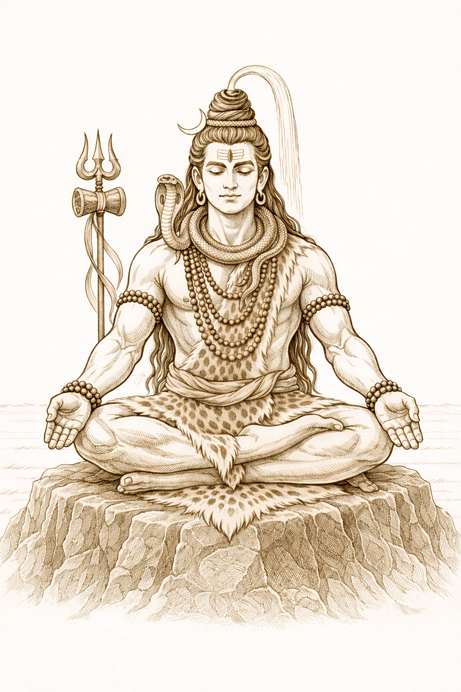
Shiva Ji
Shiva Ji is revered in Shaiva tradition as Mahadeva, the beginningless Lord. His stories move between the stillness of the ascetic and the tenderness of a householder. On Kailasa, his life with Parvati and their children unfolds alongside the great acts through which he shelters the world.
Mahamrityunjaya Mantra
Om Tryambakam Yajamahe Sugandhim Pushtivardhanam. Urvarukamiva Bandhanan Mrityor Mukshiya Maamritat॥
Day
Monday
Color
White
Bhog
Bhang and Dhatura
Festivals
Mahashivratri
Sawan Mondays
Choose Reading Section
Select one section and continue your paath in focused reading mode.
Meaning of the Name: Shiva Ji
Shiva means “auspicious” or “benevolent” in Sanskrit. It is a name for the Lord who brings well-being.
Shiva Ji: Sati, Parvati and the Lord Who Held the Poison
Shiva Ji is revered in Shaiva tradition as Mahadeva, the beginningless Lord. His stories move between the stillness of the ascetic and the tenderness of a householder. On Kailasa, his life with Parvati and their children unfolds alongside the great acts through which he shelters the world.
Sati and the sacrifice of Daksha
Sati, daughter of Daksha, had married Shiva. The Bhagavata describes Sati arriving at a great gathering where her mother and sisters received her, but her father withheld a welcome. There was no sacrificial share for Shiva. Sati challenged Daksha’s contempt for a Lord whom she knew as generous and free from rivalry. Her departure from life is described there through yogic fire. Shiva’s attendant Virabhadra subsequently broke up the sacrifice. The account does not stop at devastation: when the devas sought reconciliation, Shiva allowed Daksha to be restored and the interrupted rite to be completed. Wrath gives way to a chance to begin again.
Parvati’s devotion
Sati was born again as Parvati, daughter of Himavan and Mena. Through sustained devotion and austerity she sought Shiva. Their marriage joined the mountain maiden and the great yogi, and their family stories include Ganesha and Kartikeya. In the image of Ardhanarishvara, Shiva and Shakti appear as inseparable aspects of one divine reality.
The Shiva Purana gives Parvati’s resolve its own place in this story. The seven sages questioned her choice, pointing to Shiva’s unusual appearance and life of renunciation. Their words did not turn her from him. She understood her commitment as more than attraction to royal splendour or comfort. The testing, the approach to her family and the wedding preparations unfold over several chapters; the marriage is the fulfilment of a long undertaking.
The household at Kailasa then becomes a setting for a different kind of sacred story. Shiva can be withdrawn in meditation and still respond to Parvati and their children. Ardhanarishvara gives this companionship a visible form: the image joins Shiva and the Goddess in one body. In Shaiva understanding, stillness and creative power are not strangers to one another. The mountain home allows devotees to approach the great ascetic through affection as well as awe.
How Shiva became Neelkanth
During the churning of the ocean, a deadly poison emerged before the gifts the devas and asuras hoped to obtain. The frightened beings sought refuge in Shiva. The Bhagavata Purana describes him accepting the poison out of compassion, with Bhavani’s assent. It darkened his throat, giving him the name Neelkanth, the blue-throated Lord.
The danger of the poison interrupts a contest for immortality. Neither the devas nor the asuras had set out to bring suffering upon the worlds, yet the churning released something they could not master. Shiva’s response turns attention from the desired nectar to those already in danger. His blue throat preserves the memory of accepting that burden. In prayer, the name Neelkanth therefore recalls an act of protection, not merely a colour in an image.
Ganga held in the matted locks
Bhagiratha sought to bring Ganga to earth for the release of his ancestors. Ganga asked who could bear the force of her descent, and Bhagiratha turned to Shiva in prayer. Shiva received her upon his head, allowing her water to reach the world safely and complete the king’s long effort.
Bhagiratha’s achievement depended upon more than bringing a river down. Its descent had to become a blessing for the earth it touched. Shiva’s matted locks give the force of Ganga a place to rest before she flows onward. The king’s perseverance, the river’s grace and Shiva’s shelter work together in the story. This is why the small stream shown in Shiva’s hair carries the memory of an entire journey and the release of generations.
As Nataraja his dance expresses the movement of creation and dissolution; as the silent yogi he remains a focus of meditation. His story continues in these recurring manifestations rather than ending with a mortal departure.
Choose Reading Section
Select one section and continue your paath in focused reading mode.