Ram Ji
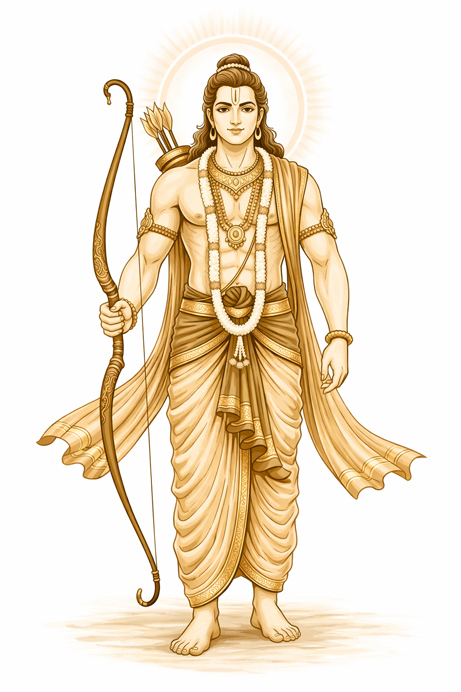
Shri Ram was born in Ayodhya to King Dasharatha and Queen Kaushalya. Bharata, Lakshmana and Shatrughna were his brothers. The Ramayana follows him from a prince’s education into decisions that test his love for family and his commitment to dharma.
Ram Tarak Mantra
Shri Ram Jai Ram Jai Jai Ram
Day
Thursday
Color
Yellow
Bhog
Fruits
Festivals
Ram Navami
Diwali
Choose Reading Section
Select one section and continue your paath in focused reading mode.
Meaning of the Name: Ram Ji
Rama means “pleasing” or “delightful”. It comes from the Sanskrit root ram, meaning to take delight. Devotees connect this meaning with the joy of remembering Shri Ram.
Shri Ram: Ayodhya, Exile and the Return of Its King
Shri Ram was born in Ayodhya to King Dasharatha and Queen Kaushalya. Bharata, Lakshmana and Shatrughna were his brothers. The Ramayana follows him from a prince’s education into decisions that test his love for family and his commitment to dharma.
Vishvamitra and the marriage in Mithila
As a young prince, Rama accompanied the sage Vishvamitra with Lakshmana and protected his sacrifice. In Mithila he lifted and broke the great bow of Shiva. He married Sita, the daughter raised by King Janaka, and returned to Ayodhya.
Vishvamitra’s visit first took Rama beyond the protected life of the palace. Dasharatha was reluctant to send his young son, but the sage’s request opened a period of learning and responsibility. With Lakshmana beside him, Rama encountered forest hermitages and the dangers that troubled their rites. The journey to Mithila followed this service. Janaka’s bow was no ordinary test of courtly skill: when it broke, the event brought the two royal families together, and the brothers’ marriages were celebrated as part of the same occasion.
Fourteen years in the forest
Before Rama’s coronation, Kaikeyi asked Dasharatha to fulfil two promised boons: Bharata should rule, and Rama should live in exile for fourteen years. Rama left with Sita and Lakshmana. Bharata refused to treat the kingdom as his own and placed Rama’s sandals on the throne as a sign of his brother’s authority.
Bharata had been away when the arrangements for exile were made. On returning, he rejected the benefit obtained in his name and went to the forest to ask Rama to come back. Their meeting brought two understandings of duty face to face: Bharata wanted to repair an injustice, while Rama would not set aside his father’s word. The sandals allowed Bharata to govern as a trustee until the promised years were over. Waiting became his own form of service.
In the forest, Ravana abducted Sita. Rama’s search brought him to Hanuman and Sugriva. After Hanuman found Sita in Lanka, Rama’s allies built a crossing over the sea. In the war that followed, Rama defeated Ravana and reunited with Sita. The Valmiki account also includes her ordeal by fire and Agni’s affirmation of her purity; later retellings explain this episode in different ways.
The search for Sita passed through loss and unexpected friendship. Jatayu, who had tried to stop Ravana, gave Rama news before dying. Shabari received the brothers at her hermitage and directed their journey onward. At Kishkindha, the alliance with Sugriva brought the search within reach of many lands. The southern party’s discovery that Sita was in Lanka led to Hanuman’s crossing and his return with a message of hope.
Before the battle, Vibhishana left Ravana and sought Rama’s shelter. Rama accepted him despite the doubts raised by some allies. This moment is remembered as an assurance of refuge. The war itself demanded the efforts of many: the bridge builders, messengers, vanara warriors and Lakshmana all had their part. Rama’s victory emerges from this community of service as well as his own confrontation with Ravana.
Return and the later story
Rama returned to Ayodhya when the exile ended and was crowned king. The Uttar Kanda carries the story further: Sita’s life at Valmiki’s hermitage, the birth of Lava and Kusha, her return to the Earth, and Rama’s eventual departure through the Sarayu. Many devotional retellings close at the coronation instead.
These difficult later episodes have inspired different interpretations across Ramayana traditions. Throughout them, Rama is remembered as Maryada Purushottam, the Lord whose story asks what duty demands when personal affection, public responsibility and suffering meet.
Child form page
Ram Lalla
Open the focused Ram Lalla page for aarti, mantra, Ayodhya context, and puja.
OpenChoose Reading Section
Select one section and continue your paath in focused reading mode.