

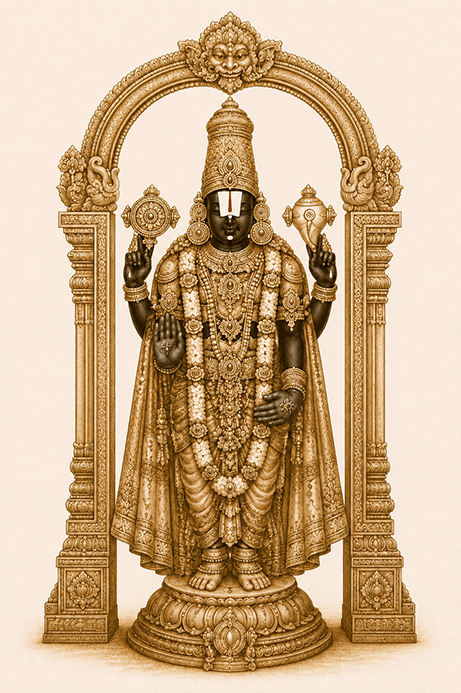
Lord Venkateswara Balaji
Lord Venkateswara, also called Srinivasa and Balaji, is worshipped at Tirumala as a manifestation of Vishnu. The temple’s own account draws together several Puranic traditions. It tells how the Lord made the Venkata hills his abode for the sake of devotees.
Venkatesha Mool Mantra
Om Namo Venkateshaya
Day
Thursday
Color
Yellow
Bhog
Panchamrit
Festivals
Vaikuntha Ekadashi
Tirupati Brahmotsavam
Choose Reading Section
Select one section and continue your paath in focused reading mode.
Meaning of the Name: Lord Venkateswara Balaji
Venkateswara means “Lord of Venkata”: Venkata is the sacred hill and Ishwara means lord. Balaji is a widely used reverential name for this form of Vishnu worshipped at Tirumala.
Venkateswara Balaji: Srinivasa and Padmavati at Tirumala
Lord Venkateswara, also called Srinivasa and Balaji, is worshipped at Tirumala as a manifestation of Vishnu. The temple’s own account draws together several Puranic traditions. It tells how the Lord made the Venkata hills his abode for the sake of devotees.
Lakshmi’s departure and Srinivasa’s stay on earth
In the temple legend, the sage Bhrigu visits the divine abodes and strikes Vishnu’s chest. Lakshmi, whose abode is upon that chest, leaves in distress. Vishnu comes to earth as Srinivasa. His stay in the hills includes the care of Vakula Devi, who is remembered as a mother to him.
The Tirumala legend follows Srinivasa into an anthill where a cow secretly nourishes him with her milk. When the missing milk alarms the household responsible for the herd, a cowherd follows her and raises his weapon. The Lord receives the blow while protecting the animal. This episode places vulnerability and compassion within the story of the deity later approached in royal splendour. Before the great wedding and the temple’s majesty, there is a hidden dwelling, a daily act of feeding and a life protected from violence.
The sacred landscape is already associated with Varaha. Tirumala’s tradition gives Varahaswami an honoured place and connects Srinivasa’s residence with his permission. The story therefore places the shrine within an older sacred setting.
Vakula Devi’s place is especially tender. Tirumala tradition connects her with Yashoda, whose wish to see Krishna’s marriage is fulfilled in this later manifestation. Her care for Srinivasa extends from attending to his needs to acting on his behalf when marriage becomes possible. Through her, the story carries the warmth of a mother’s unfinished longing from one divine lila into another.
The marriage to Padmavati
Padmavati, the princess raised by Akasha Raja, meets Srinivasa. The account unfolds through their wish to marry, Vakula Devi’s help and the families’ arrangements. Srinivasa’s borrowing from Kubera for the wedding is a familiar part of this temple tradition.
The wedding account describes Padmavati as a child discovered upon a lotus by Akasha Raja. Her name and upbringing connect the royal household to a sacred gift. When Srinivasa meets her, the encounter leads to messages and arrangements between their families. Vakula’s part keeps affection and practical care close together. The borrowing from Kubera supplies the means for the celebration, giving later devotees a place within its memory through their offerings.
The annual Padmavati Parinayam festival recalls this marriage. For pilgrims, the celebration does not replace the daily presence of Venkateswara in the sanctum; it opens another way to remember him. Procession, marriage and household affection bring movement to the still image of the Lord upon the hill. The mountain shrine holds both the grandeur of Vishnu and the intimacy of Srinivasa’s earthly relationships.
Devotees connect their offerings with the Lord’s sacred marriage and service at Tirumala. The borrowing is a devotional narrative, not a promise of personal financial reward in exchange for an offering.
The story culminates in Venkateswara’s abiding presence on the hill. His manifestation is not given a human death: pilgrims come because he is believed to remain accessible there. The marriage, the care of Vakula Devi and the bond with Lakshmi bring an intimate household warmth to the majestic form in the sanctum.
Choose Reading Section
Select one section and continue your paath in focused reading mode.