Brahma Ji
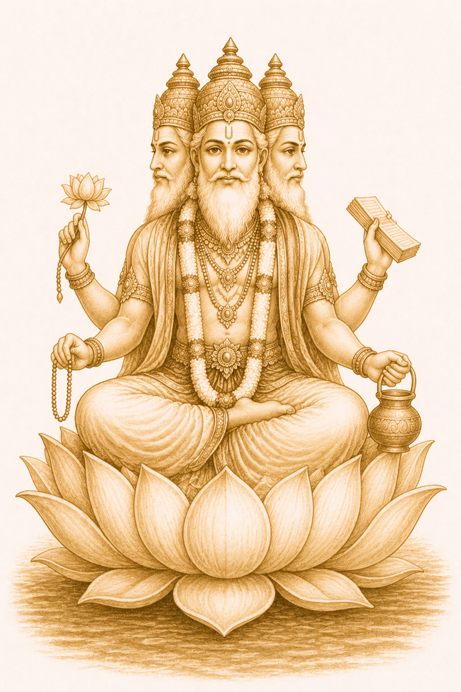
In the Bhagavata Purana’s account of creation, Brahma Ji appears upon a lotus arising from Vishnu’s navel. Around him stretches the cosmic water. Before he can create, he must discover where he has come from and what he has been called to do.
Simple Brahma Mantra
Om Brahmane Namah
Day
Thursday
Color
Yellow
Bhog
Panchamrit
Choose Reading Section
Select one section and continue your paath in focused reading mode.
Meaning of the Name: Brahma Ji
Brahma is the name of the creator deity. It belongs to the Sanskrit word family associated with growth and greatness. Brahma, the personal deity, should be distinguished from Brahman, the term for ultimate reality.
Brahma Ji: The Lotus and the Beginning of Creation
In the Bhagavata Purana’s account of creation, Brahma Ji appears upon a lotus arising from Vishnu’s navel. Around him stretches the cosmic water. Before he can create, he must discover where he has come from and what he has been called to do.
He looks in the different directions and searches down the lotus stalk, but does not find its source by exploration alone. Returning to the lotus, he turns inward in meditation. The account presents his knowledge of Narayana as the foundation of his creative work.
The lotus offers Brahma a seat but not an immediate explanation of his existence. Surrounded by the cosmic waters, he asks where he has come from and what supports him. His downward search ends without an answer. Only after returning and becoming still does he perceive the Lord upon the serpent couch. In the Bhagavata’s telling, the first task of the creator is therefore to become a seeker. The world he will help to shape begins with received understanding rather than self-sufficiency.
The work of the creator
Brahma brings forth sages and progenitors through whom living beings multiply. The four Kumaras and Narada belong to the stories of his mind-born children. Creation does not unfold as a simple act of command: the Kumaras choose the life of spiritual inquiry, and the Puranas describe further stages through which the world takes shape.
Sanaka, Sanandana, Sanatana and Sanatkumara do not take up the household role Brahma intended for them. They choose contemplation and remain devoted to spiritual knowledge. Their refusal leads to a new turn in the creation narrative, including the appearance of Rudra. Brahma has to guide and redirect the forces that emerge, rather than merely bring them into being. The text then speaks of further sages, and of Manu and Shatarupa, through whom another stage of human lineage begins.
These episodes give creation both movement and difficulty. The creator encounters wills that differ from his own and powers that need an appropriate place. His work involves recognising different purposes: the Kumaras’ renunciation has a place in the universe even though it does not fulfil his immediate wish for descendants. Knowledge, restraint and the continuation of life all belong within the world being formed.
His four faces are traditionally associated with the four Vedas. Saraswati is closely connected with him as the goddess of learning and speech. Brahma the creator is distinct from Brahman, the term used for ultimate reality in Hindu philosophy; the similar English spellings can obscure that difference.
Creation within the cycles of time
The Bhagavad Gita describes vast days and nights of Brahma, during which beings manifest and withdraw. His role belongs to this sacred vision of recurring worlds. Other texts preserve different creation accounts, so the lotus narrative is one major Puranic telling rather than the only account accepted by every tradition.
A day of Brahma is described in the Gita as a thousand cycles of the four yugas, with a night of corresponding length. At dawn beings manifest again; at night they return to an unmanifest condition. The scale changes how a reader sees a single human lifetime. Even the creator’s activity has its rhythm of emergence and rest. Brahma remains great within this account, yet the reality from which he receives his task is greater than the span of a created world.
Brahma’s story begins with a question before it reaches creation. He must listen and understand before shaping the world. Devotees remember in him the responsibility that accompanies knowledge and the humility of seeking the source of one’s own power.
Choose Reading Section
Select one section and continue your paath in focused reading mode.