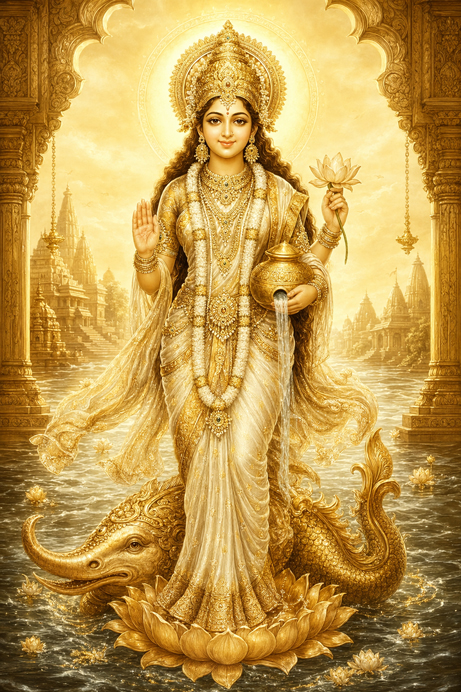
Ganga Mata
Ganga Mata’s descent is tied to a family’s long effort to bring peace to its ancestors. The sons of King Sagara had been reduced to ashes after offending the sage Kapila. Their descendants sought the sacred water that could bring them release.
Simple Ganga Mantra
Om Shri Gangayai Namah
Day
Monday
Color
White
Bhog
Fruits
Choose Reading Section
Select one section and continue your paath in focused reading mode.
Meaning of the Name: Ganga Mata
Ganga is the ancient Sanskrit name of the sacred river and the Goddess worshipped through it. Bhagirathi recalls Bhagiratha’s role in bringing her to earth, while Jahnavi connects her with the sage Jahnu.
Ganga Mata: Bhagiratha’s Prayer and the Descent to Earth
Ganga Mata’s descent is tied to a family’s long effort to bring peace to its ancestors. The sons of King Sagara had been reduced to ashes after offending the sage Kapila. Their descendants sought the sacred water that could bring them release.
Bhagiratha’s perseverance
After earlier generations had tried, Bhagiratha undertook austerities and sought Ganga’s descent. She agreed, but asked who could bear the force of her fall. A river descending from heaven could overwhelm the earth unless its power was received and guided.
The task had passed through generations. Sagara’s descendants could not simply repair the loss through royal power, and Bhagiratha inherited an unfinished responsibility. His austerities are remembered as perseverance on behalf of others. Even after Ganga agrees, a second prayer is needed to Shiva. The sequence gives the descent its depth: an earnest wish must be joined to the conditions that make its fulfilment safe for the world.
Bhagiratha then worshipped Shiva. Shiva accepted Ganga upon his head, allowing her waters to reach the world without destroying it. She followed Bhagiratha to the ashes of his ancestors and brought them release. The name Bhagirathi remembers the king’s part in this journey.
Jahnavi and the many sacred connections
The Ramayana’s descent narrative also tells of the sage Jahnu receiving and then releasing her waters, giving rise to the name Jahnavi. Other passages connect Ganga with Himavan, or describe her sacred association with Vishnu’s foot. These express different aspects of her divine origin.
In the Ramayana, Ganga’s waters enter Jahnu’s sacrificial ground. The sage drinks them, interrupting the great journey. The devas and sages appeal to him, and he releases the river again. Calling her Jahnavi remembers this relationship to Jahnu. Even after the heavenly descent has been accomplished, Bhagiratha’s effort still encounters a new obstacle and a new act of grace.
The river finally reaches the place where Sagara’s sons lie as ashes. Her touch completes what the earlier generations had sought. Bhagiratha’s name remains attached to the stream because the story preserves the human persistence alongside divine generosity. In everyday speech, a Bhagiratha-like effort still evokes a difficult undertaking carried through for the benefit of many.
In the Mahabharata, Ganga appears as the mother of Devavrata, later known as Bhishma, through her marriage to Shantanu. That is another important strand of her story, distinct from Bhagiratha’s quest.
The Mahabharata account gives that motherhood a sorrowful background. The eight Vasus have been destined for earthly birth, and Ganga becomes their mother. Shantanu has agreed not to question her actions, but stops her when she is about to take their eighth child to the river. She then explains the Vasus’ story and departs with the surviving child. Devavrata is later returned to his father after receiving his education. Ganga’s relationship with Bhishma thus includes separation, care and the fulfilment of a destiny older than their meeting on earth.
Ganga’s narrative continues as a flowing presence, not a life ending in death. Pilgrimage, remembrance of ancestors and daily prayer gather along her banks. The descent also carries a human responsibility: a river honoured as a mother calls for care for the water and the lives it sustains.
Choose Reading Section
Select one section and continue your paath in focused reading mode.