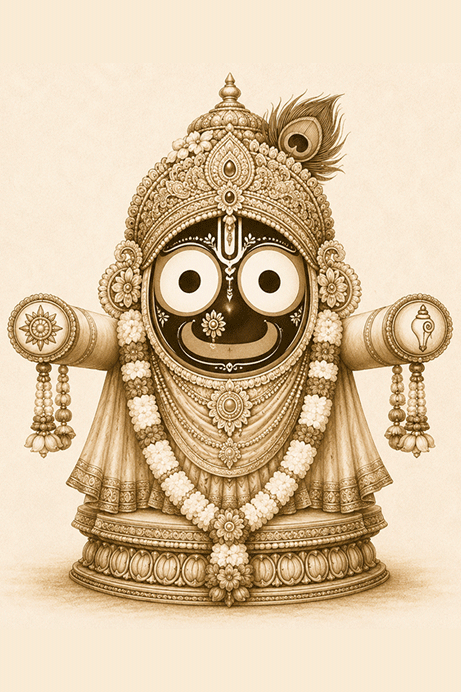
Jagannath Ji
King Indradyumna’s search for Nila Madhava stands at the heart of a well-known Jagannath temple legend. The search leads to a forest worshipped by Vishvavasu and, eventually, to the sacred wooden forms at Puri. Jagannath is worshipped there with Balabhadra, Subhadra, and Sudarshana. The search, the carving of the images, and their journey by chariot give this tradition its distinctive story.
Jagannath Mool Mantra
Om Jagannathaya Namah
Day
Thursday
Color
Yellow
Bhog
Fruits
Festivals
Jagannath Rath Yatra
Janmashtami
Choose Reading Section
Select one section and continue your paath in focused reading mode.
Meaning of the Name: Jagannath Ji
Jagannath means “Lord of the world”. It joins the Sanskrit words jagat, meaning world, and natha, meaning lord. This is the familiar name of the deity worshipped at Puri.
Jagannath Ji: From Nila Madhava to the Chariots of Puri
King Indradyumna’s search for Nila Madhava stands at the heart of a well-known Jagannath temple legend. The search leads to a forest worshipped by Vishvavasu and, eventually, to the sacred wooden forms at Puri. Jagannath is worshipped there with Balabhadra, Subhadra, and Sudarshana. The search, the carving of the images, and their journey by chariot give this tradition its distinctive story.
The search for Nila Madhava
The worship of Shri Jagannath has ancient roots and combines Vedic, Vaishnava, tribal, and devotional traditions. Lord Jagannath is worshipped together with his elder brother Lord Balabhadra and his sister Devi Subhadra. Their unique wooden forms are installed in the famous Jagannath Temple of Puri, one of the holiest pilgrimage sites in India.
According to a popular legend, King Indradyumna of Malwa desired to have darshan of the divine form of Lord Vishnu known as Nila Madhava. After a long search, the king learned of the Lord's mysterious presence in a forest shrine. When he reached the sacred location, the deity had disappeared, but he received divine instructions to build a grand temple and establish the Lord's worship there.
The Lord later appeared in the form of sacred wooden logs known as Daru Brahma, which floated to the shore. Lord Vishwakarma, disguised as a carpenter, agreed to carve the divine forms under the condition that he would not be disturbed during his work. However, before the work was completed, the king opened the door. The divine forms appeared unfinished, with large eyes and incomplete limbs. A heavenly voice declared that this was the form in which the Lord wished to be worshipped. Thus emerged the unique forms of Jagannath, Balabhadra, and Subhadra.
One of the most celebrated festivals associated with Jagannath Ji is the Rath Yatra. During this grand festival, the Lord, along with Balabhadra and Subhadra, travels in magnificent chariots from the Jagannath Temple to the Gundicha Temple. Millions of devotees pull the chariots while chanting the Lord's names, symbolizing the Lord coming out to bless all people regardless of social status or background.
The tradition of Mahaprasad is another unique aspect of Jagannath worship. Food offered to the Lord is regarded as sacred and is distributed equally among devotees. This practice emphasizes unity, equality, gratitude, and the Lord's boundless compassion toward all beings.
The great saint Adi Shankaracharya, Sri Ramanujacharya, Sri Chaitanya Mahaprabhu, and many other saints expressed deep devotion to Jagannath Ji. Sri Chaitanya Mahaprabhu, in particular, spent many years in Puri immersed in ecstatic devotion to Lord Jagannath.
Jagannath Ji is often understood as Lord Krishna in a state of divine love and spiritual ecstasy. His large eyes symbolize constant compassion and watchfulness over all creation, while his open form represents the Lord's accessibility to every sincere devotee.
Rath Yatra, Mahaprasad, and the Lord of Puri
The worship of Jagannath Ji teaches universal love, humility, devotion, equality, and surrender to God. He is regarded as the compassionate Lord who embraces all beings without discrimination.
Lord of the Universe
Jagannath means 'Lord of the Universe.' His worship reminds devotees that God belongs to all people and transcends every worldly division.
Symbol of Universal Compassion
Jagannath Ji accepts every devotee regardless of background, status, or circumstance. His grace is considered available to all sincere seekers.
The Meaning of the Large Eyes
The Lord's large eyes symbolize constant awareness, compassion, and protection. They represent the divine presence watching over all beings at all times.
Significance of Rath Yatra
The Rath Yatra teaches that the Lord comes out of the temple to meet all people. It symbolizes divine accessibility, inclusiveness, and universal blessings.
Importance of Mahaprasad
Mahaprasad represents equality, gratitude, and divine nourishment. It reminds devotees that all food is a gift of God and should be respected and shared.
Lesson of Humility
The worship of Jagannath Ji encourages humility and surrender. Devotees are taught to place faith in divine wisdom rather than ego and pride.
Symbol of Divine Love
Jagannath Ji is often associated with the highest form of Krishna's divine love. His worship awakens devotion, compassion, and spiritual joy in the heart.
Unity in Diversity
The traditions of Jagannath worship bring together people from different cultures, communities, and spiritual paths, reflecting the Lord's universal nature.
Path of Bhakti
Devotion to Jagannath Ji emphasizes simple and heartfelt bhakti. Sincere remembrance of the Lord is considered more important than external complexity.
Bestower of Liberation
Jagannath Ji is worshipped as the Supreme Lord who grants spiritual progress, inner peace, divine grace, and ultimately liberation from worldly suffering.
Jagannath Ji is the compassionate Lord of the Universe who embraces all beings with unconditional love. His worship teaches humility, equality, devotion, gratitude, and surrender to God. Through remembrance of Jagannath Ji, devotees seek divine protection, spiritual wisdom, and everlasting peace. Jai Jagannath!
Choose Reading Section
Select one section and continue your paath in focused reading mode.