Mahakali Mata
Mahakali is worshipped as the Divine Mother whose power reaches beyond time and dissolution. Her name and forms are understood differently across Shakta traditions. The Devi Mahatmya’s accounts of the goddess’s cosmic power and of Kali on the battlefield are central to her worship, but they should not be collapsed into a single birth-to-death biography.
Mool Mantra
Om Hreem Shreem Kleem Aadya Kaalika Param Eshwari Swaha
Day
Saturday
Color
Black
Bhog
Halwa
Festivals
Kali Puja
Navratri
Choose Reading Section
Select one section and continue your paath in focused reading mode.
Meaning of the Name: Mahakali Mata
Mahakali means “Great Kali”; maha means great. In Shakta worship, this name refers to Kali in her vast form, beyond the limits of time.
Mahakali Mata: The Great Mother, Time, and the Defeat of Raktabija
Mahakali is worshipped as the Divine Mother whose power reaches beyond time and dissolution. Her name and forms are understood differently across Shakta traditions. The Devi Mahatmya’s accounts of the goddess’s cosmic power and of Kali on the battlefield are central to her worship, but they should not be collapsed into a single birth-to-death biography.
Chandika, Chamunda, and Raktabija
The Devi Bhagavata Purana and the Markandeya Purana describe the appearance of Maa Mahakali. In ancient times, two mighty demon brothers, Shumbha and Nishumbha, conquered the three worlds. They drove the gods from heaven and spread chaos throughout creation. Terrified, the gods went to the Himalayas and prayed to the Divine Mother. Hearing their pleas, a radiant power emerged from the body of Goddess Parvati. This divine force was known as Ambika or Chandika, and later manifested as Mahakali.
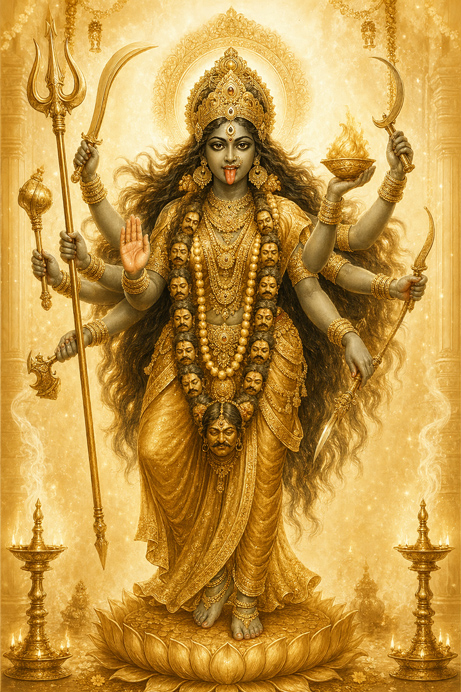
One of the most famous stories of Mahakali is connected with the destruction of Chanda, Munda, and Raktabija. While Goddess Durga was battling the demons Chanda and Munda, Mahakali emerged from her intense anger. Her appearance was awe-inspiring and terrifying—dark complexion, disheveled hair, blazing red eyes, protruding tongue, and a garland of severed heads around her neck. She slew Chanda and Munda, earning the name Chamunda. Her fierce form symbolizes the destruction of evil and unrighteousness.
In the Devi Mahatmya, every drop of Raktabija’s blood that reaches the ground produces another warrior. Chandika directs Kali, also called Chamunda, to catch the blood and consume the beings arising from it. Chandika strikes Raktabija while Kali prevents his multiplication. Their coordinated action defeats him; Kali does not act alone throughout the battle.
Kali standing upon Shiva has its own devotional explanations. A widely told later account says Shiva lies in her path and recognising him stills her destructive dance. Other interpretations emphasise consciousness and power as inseparable. These later details should not be appended to the Raktabija chapter as if they all appeared there.
At Dakshineswar, Sri Ramakrishna’s worship of Kali made the bond between devotee and Mother central to his spiritual life. His biographical tradition describes longing, prayer, and experiences of her presence. This intimacy offers a different setting from the battlefield narratives, without requiring devotees to imitate the extreme experiences recorded in a saint’s life.
Kali worship has distinct regional forms, including Bhadrakali traditions in Kerala. Temple narratives centre on different adversaries, places, and ritual histories. Keeping those accounts distinct allows their local voices to be heard instead of turning them into an unnamed battle offered as the origin of all southern worship.
Though Mahakali's appearance may seem fierce and terrifying, she is infinitely compassionate toward her devotees. Her dark complexion symbolizes the infinite cosmos that embraces all existence. The garland of heads around her neck represents the destruction of ego. Her flowing hair signifies absolute freedom beyond illusion. One of her hands grants blessings while another offers fearlessness, assuring devotees of protection and fulfillment of righteous desires.
The fierce Mother and the assurance of fearlessness
The story of Maa Mahakali teaches that evil, ego, and unrighteousness are ultimately destined to perish. She is the supreme goddess of power, courage, fearlessness, and transformation. Her glory reminds us that whenever creation is threatened, the Divine Mother manifests to protect righteousness.
Adyashakti — The Source of All Power
Maa Mahakali is called Adyashakti, the primordial source of all divine energies. The creative power of Brahma, the sustaining power of Vishnu, and the transformative power of Shiva all arise from her. She is the supreme manifestation of divine energy.
Mistress of Time
Mahakali governs time itself. She exists beyond time and controls its flow. Through her worship, devotees seek freedom from the fear of death. She teaches that one who transcends the fear of time becomes truly fearless and spiritually liberated.
Destroyer of Ego and Bestower of Liberation
The garland of heads worn by Mahakali symbolizes the destruction of ego. She removes pride, attachment, greed, and fear from the hearts of her devotees. When ego is dissolved, the path to liberation opens. Therefore, she is revered as the giver of moksha.
Destroyer of Evil
Mahakali destroys unrighteousness, sin, and demonic tendencies. Through the slaying of Chanda, Munda, Raktabija, and many other demons, she established righteousness. Her stories remind us that no matter how powerful evil appears, its defeat is inevitable.
Goddess of Fearlessness and Courage
Mahakali grants courage and fearlessness to her devotees. Her worship removes inner anxieties and strengthens the spirit. Her Abhaya Mudra signifies that those who seek refuge in her need not fear anything.
Presiding Goddess of Tantric Traditions
Mahakali occupies a central place in many tantric traditions and is regarded as the foremost among the Ten Mahavidyas. Spiritual practitioners revere her as a source of profound transformation. Her worship is believed to help overcome negativity, obstacles, and adverse influences.
Symbol of the Unity of Shiva and Shakti
The relationship between Mahakali and Lord Shiva represents the inseparable union of consciousness and energy. Shiva symbolizes pure awareness, while Kali represents dynamic power. Together they embody the balance that sustains the universe.
Protector of Devotees and Fulfiller of Wishes
Mahakali constantly protects her devotees. Though fierce toward evil, she is a loving and nurturing mother to those who seek her refuge. She removes suffering, fear, and obstacles while blessing sincere devotees with spiritual and worldly well-being.
Kali Puja and the Festival of Deepavali
On the night of Kartik Amavasya, which coincides with Deepavali, special worship of Maa Kali is performed. Kali Puja is celebrated with great devotion, particularly in West Bengal. Temples such as Kalighat and Dakshineswar attract millions of devotees seeking her blessings.
Navaratri and the Worship of Divine Power
During the sacred festival of Navaratri, the worship of Mahakali holds special significance. The first three days are traditionally associated with forms of the Divine Mother that help devotees overcome inertia, negativity, and fear. Her worship inspires strength, courage, and self-confidence.
Maa Mahakali is not merely the goddess of destruction; she is the supreme embodiment of liberation, power, fearlessness, transformation, and boundless compassion. Her fierce form is terrifying to evil, yet deeply loving toward her devotees. Through her worship, ego is dissolved, fear is removed, obstacles are overcome, and ultimately liberation is attained. Maa Mahakali teaches that whenever darkness and adversity arise in life, one should seek refuge in the Divine Mother, who never fails to protect her children. Jai Maa Mahakali!
Choose Reading Section
Select one section and continue your paath in focused reading mode.