Narasimha Dev
Prahlada was the son of Hiranyakashipu, an asura king who demanded submission to his own power. Prahlada instead remained devoted to Vishnu. The Bhagavata Purana places this conflict between a father’s pride and a child’s faith at the heart of Narasimha Dev’s appearance.
Narasimha Mool Mantra
Om Namo Narasimhaya
Day
Thursday
Color
Yellow
Bhog
Panchamrit
Festivals
Narasimha Jayanti
Vaikuntha Ekadashi
Choose Reading Section
Select one section and continue your paath in focused reading mode.
Meaning of the Name: Narasimha Dev
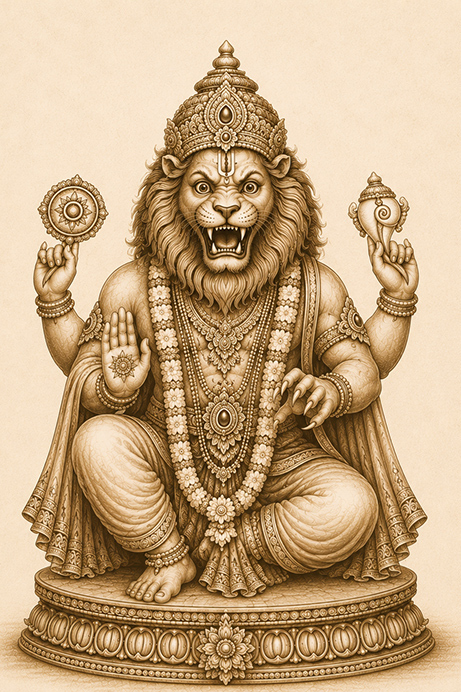
Narasimha combines nara, “human”, and simha, “lion”. The name describes Vishnu’s form with human and lion features, in which he protects Prahlada.
Narasimha Dev: Prahlada’s Faith and the Lord in the Pillar
Prahlada was the son of Hiranyakashipu, an asura king who demanded submission to his own power. Prahlada instead remained devoted to Vishnu. The Bhagavata Purana places this conflict between a father’s pride and a child’s faith at the heart of Narasimha Dev’s appearance.
Hiranyakashipu had obtained a boon from Brahma with carefully stated protections against death. Believing himself secure, he could not tolerate his son’s devotion. Threats and attempts to kill Prahlada did not make the child abandon the Lord.
Prahlada’s difficulty began in his own household. His father wanted an obedient heir who would share his hostility towards Vishnu. The teachers appointed to instruct the boy could not turn his affection away from the Lord. Asked what he had learned, Prahlada spoke of devotion rather than the ambitions expected of a prince. Hiranyakashipu heard this as defiance, but the child’s faith did not depend upon defeating his father in argument.
The Bhagavata also describes Prahlada speaking to the other children. He urges them not to postpone remembrance of the divine until old age. He recalls receiving spiritual instruction through Narada while still in his mother’s womb. This gives his quiet courage a background: his devotion has been nurtured before the royal court tries to reshape him. The threatened child is also a teacher, sharing what has sustained him.
The challenge at the pillar
When Prahlada said that the Lord was present everywhere, Hiranyakashipu demanded to know whether he was present in a pillar. He struck it, and Narasimha emerged in a form that was neither entirely human nor animal.
At twilight, in a doorway, the Lord held Hiranyakashipu upon his lap and killed him with his nails. The setting and the form fulfilled the conditions surrounding Brahma’s boon: neither day nor night, neither inside nor outside, neither on the earth nor in the sky, and no ordinary weapon.
The pillar matters because it is an apparently lifeless object in the king’s own hall. Hiranyakashipu chooses it as a test of Prahlada’s claim, confident that nothing can appear there to challenge him. The unexpected form answers both his certainty and his carefully arranged protections. Narasimha is not bound by the divisions through which the king tried to make himself invulnerable. The child’s declaration of divine presence is vindicated at the very place selected to disprove it.
Prahlada’s prayer
The story continues beyond the defeat of the king. Prahlada approached the fierce Lord and offered prayers. When offered a blessing, he did not ask for wealth or dominion; he prayed to be free of selfish desire and sought grace for his father. The Lord accepted him, and Prahlada’s rule followed.
Prahlada does not use this victory to take revenge. His concern includes the father who persecuted him. When the Lord offers boons, he asks that desire itself should not rule his heart. The conversation changes the mood from the violence of the confrontation to the freedom of a devotee who will not make worship a bargain. Narasimha’s hand upon Prahlada’s head expresses the reassurance at the centre of the story.
For devotees, Narasimha’s fierce appearance and compassion belong together. The form that terrifies the oppressor shelters the child. This is an account of Vishnu’s protective manifestation, not a separate human life with a childhood and a death.
Choose Reading Section
Select one section and continue your paath in focused reading mode.