Kali Mata
In the Devi Mahatmya, Kali Mata appears during the Goddess’s battle against the forces of Shumbha and Nishumbha. As Chanda and Munda advance, a fierce dark form emerges from Ambika’s brow. This is one of Kali’s major scriptural appearances, not an ordinary birth into a human family.
Root Mantra (Beej Mantra)
Om Kreem Kalikayai Namah ॥
Day
Friday
Color
Black
Bhog
Coconut
Festivals
Kali Puja
Navratri
Choose Reading Section
Select one section and continue your paath in focused reading mode.
Meaning of the Name: Kali Mata
Kali is the feminine form of kala in the sense of “black” or “dark”. Shakta traditions also connect her name with time and the power that transcends it.
Kali Mata: Chanda, Munda and the Battle with Raktabija
In the Devi Mahatmya, Kali Mata appears during the Goddess’s battle against the forces of Shumbha and Nishumbha. As Chanda and Munda advance, a fierce dark form emerges from Ambika’s brow. This is one of Kali’s major scriptural appearances, not an ordinary birth into a human family.
The name Chamunda
Kali confronts and defeats Chanda and Munda. Bringing the result of the battle before the Goddess, she receives the name Chamunda, preserving both opponents’ names in the memory of her victory.
The Devi Mahatmya places Kali’s appearance at a moment when Ambika is confronted by a hostile army. From the Goddess’s darkened, angry brow comes the formidable figure who rushes into the struggle. Chanda and Munda had acted on behalf of Shumbha’s claim over the Goddess. Their defeat therefore belongs to her refusal to be seized and possessed. The name Chamunda carries the memory of that particular intervention, rather than naming a different childhood or separate human life.
Stopping Raktabija
Raktabija presents another danger: each drop of his blood that reaches the ground produces another warrior like him. Simply striking him makes the enemy multiply. At Chandika’s direction, Kali prevents the blood from falling and consumes the newly formed adversaries. This allows the Goddess to overcome him.
The Matrikas are already engaged in the battle when the danger of Raktabija becomes clear. Every wound threatens to turn one adversary into many more, so courage without a changed response cannot end the conflict. Kali’s action prevents the source of multiplication from reaching the ground. The Goddess and her manifestations work together until the field is no longer being replenished with enemies. The episode gives her fierceness a definite purpose: stopping a danger that ordinary blows keep renewing.
Readers have also understood Raktabija as an image of tendencies that multiply whenever they are met without insight. That is a devotional interpretation of the battle, not a replacement for its narrative. Kali’s role is precise in both readings: she attends to what keeps the danger returning. The story makes room for discernment within its fierce imagery.
The scene has a precise place in the battle narrative. It should not be confused with later images of Kali standing upon Shiva, which belong to other devotional tellings and interpretations.
The fierce Mother
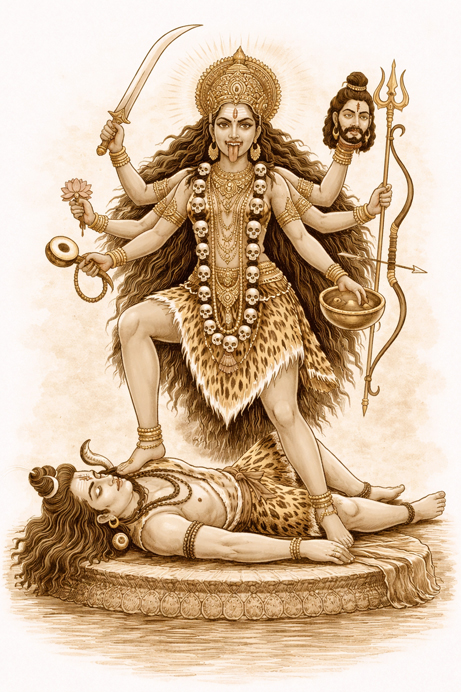
Shakta traditions also honour Kali as the Mother beyond time, the one before whom pride and the fear of death fall away. In familiar later retellings, Shiva lies in her path and her recognition of him interrupts her overwhelming movement. The details and explanations of this image vary.
In the image with Shiva, devotees often see a meeting between overwhelming divine energy and the stillness that receives it. Bengali traditions may explain the extended tongue through recognition and modesty, while other Shakta interpretations give it different meanings. A single explanation does not exhaust the image. What remains consistent in maternal devotion is the willingness to approach even this fearsome form with trust. The child who calls her Mother is not required to pretend that life contains no terror or loss.
Her frightening appearance does not exhaust her devotional identity. Bengali songs and household worship often approach her with a child’s intimacy towards a mother. Her story holds together the destruction of a grave threat and the closeness of refuge; it does not end with a mortal death.
Choose Reading Section
Select one section and continue your paath in focused reading mode.