

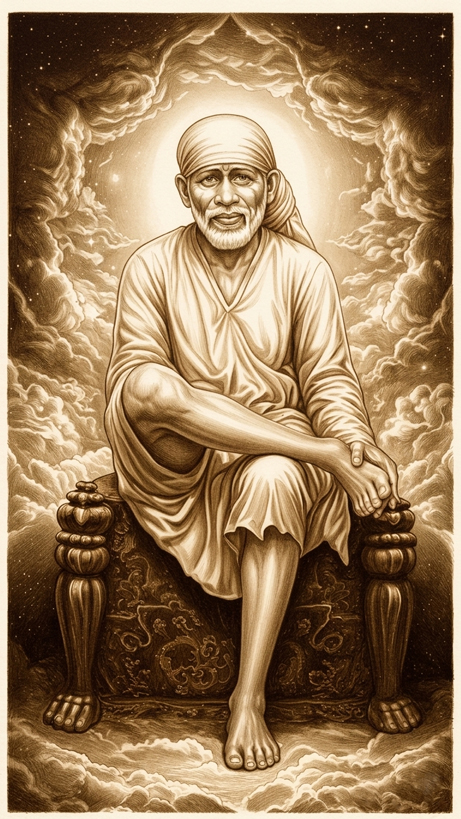
Sai Baba
Sai Baba’s early life is not securely documented. His parents, birthplace and exact birth date remain uncertain. The Sai Satcharitra introduces a young ascetic who appeared in Shirdi, spent time beneath a neem tree and later returned to make the village his home.
Sai Baba Mool Mantra (Root Mantra)
Om Sai Namah
Day
Thursday
Color
White
Bhog
Fruits
Choose Reading Section
Select one section and continue your paath in focused reading mode.
Meaning of the Name: Sai Baba
Sai Baba is a reverential name, rather than a known birth name. Sai is used as an address for a holy person, while Baba is an affectionate, respectful address for an elder or spiritual father.
Sai Baba: A Life of Compassion in Shirdi
Sai Baba’s early life is not securely documented. His parents, birthplace and exact birth date remain uncertain. The Sai Satcharitra introduces a young ascetic who appeared in Shirdi, spent time beneath a neem tree and later returned to make the village his home.
Making Shirdi home
The account of his return connects him with Chand Patil’s wedding party. On arriving near the Khandoba temple, he was greeted by Mhalsapati with the name Sai. He eventually lived in the mosque remembered as Dwarkamai, where the sacred fire, or dhuni, became part of daily life.
The Satcharitra describes Chand Patil searching for a missing mare when he encountered the young fakir. That meeting led to companionship and, later, the journey with the wedding party to Shirdi. Baba’s arrival was not presented as the entrance of a wealthy religious leader. He lived simply, wore a kafni and became familiar to people through repeated daily encounters. The mosque, the village paths and the homes from which he received alms formed the setting of his life.
Baba begged for food, shared what he received and lived among the villagers. People from Hindu and Muslim backgrounds came to him. His teaching was often conveyed through an everyday encounter, a short story or an act of care rather than a formal lecture.
Faith, patience and care for others
The Sai tradition especially remembers shraddha and saburi—faith and patience. The Satcharitra recounts devotees’ experiences of his insight, help and miracles. These are received as testimonies of faith. His distribution of udi, the ash of the dhuni, remains an important part of that devotional memory.
The lamps and the lesson of kindness
Chapter five recounts the episode of the village oil sellers refusing oil for Baba’s lamps. The devotional account says that he used water and the lamps nevertheless burned. When the sellers recognised their fault, the lesson concerned their conduct: they should speak truthfully and act kindly. The miracle is remembered within a relationship with neighbours, not as a spectacle detached from ordinary life.
Baba’s concern extended to feeding the hungry and treating people and animals with compassion. Devotion to him was expressed through the way a person met another’s need, not only through words spoken in prayer.
A particularly tender account concerns Mrs Tarkhad feeding a hungry dog before her own meal. Later Baba told her that her act had satisfied him. When she was puzzled, he connected the food given to the animal with service offered to himself. The story asks the listener to recognise need before judging the form in which it appears. A small piece of bread becomes the centre of a teaching about the presence of the divine in living beings.
Another Tarkhad family episode concerns an offering forgotten at home while family members were in Shirdi. Baba’s words about returning hungry and the letters exchanged by the family are narrated as evidence of his awareness. Alongside that devotional claim lies a familiar human concern: a daily prayer can become mechanical unless attention and affection remain within it. These household stories explain why his memory became so closely woven into the routines of his followers.
Sai Baba passed away in Shirdi on 15 October 1918, on Vijayadashami. Devotees call this his Mahasamadhi. His resting place became the Samadhi Mandir, and Shirdi continues to remember the life he spent among its people.
Choose Reading Section
Select one section and continue your paath in focused reading mode.