

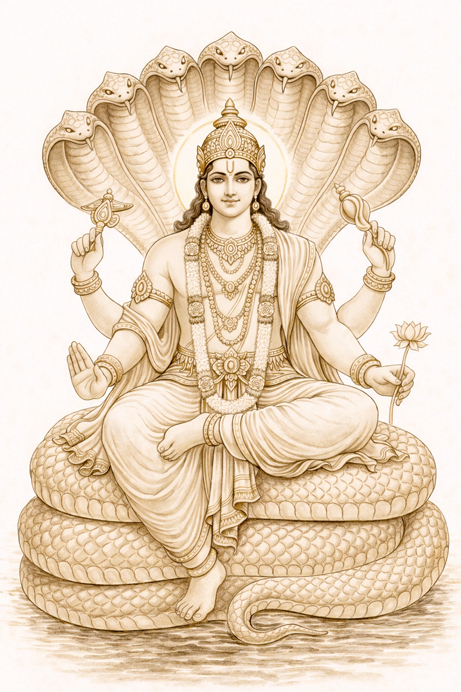
Lord Vishnu
Lord Vishnu is revered in Vaishnava traditions as the eternal protector of the world. The Puranic image of Narayana resting on Ananta upon the cosmic waters places him before the next unfolding of creation. Lakshmi is his divine consort, and Brahma appears upon the lotus associated with the beginning of a new creation.
Dwadashakshar Mantra
Om Namo Bhagavate Vasudevaya
Day
Thursday
Color
Yellow
Bhog
Panchamrit
Festivals
Vaikuntha Ekadashi
Gita Jayanti
Choose Reading Section
Select one section and continue your paath in focused reading mode.
Meaning of the Name: Lord Vishnu
Vishnu is traditionally understood to mean “the one who is present everywhere”. This is why he is often called the all-pervading Lord.
Lord Vishnu: The Preserver and His Descents into the World
Lord Vishnu is revered in Vaishnava traditions as the eternal protector of the world. The Puranic image of Narayana resting on Ananta upon the cosmic waters places him before the next unfolding of creation. Lakshmi is his divine consort, and Brahma appears upon the lotus associated with the beginning of a new creation.
Protection during the churning of the ocean
When the devas and asuras churned the ocean for amrita, the mountain used as their churning rod began to sink. Vishnu supported it in his Kurma, or tortoise, form. Later, as Mohini, he intervened in the dispute over the nectar. The account presents preservation as patient support as well as decisive action.
Kurma’s part in the churning is easily passed over because it takes place beneath the surface. Mount Mandara needs a foundation before anyone can obtain the treasures of the ocean. Vishnu supplies that support while the opposing groups continue their labour. When the nectar finally appears, another difficulty arises over its possession. The Mohini episode resolves that struggle in favour of the devas. Together the two manifestations show different kinds of intervention within a single undertaking: bearing its weight and guiding its outcome.
The avatars
Vishnu’s descents respond to different dangers. As Varaha he raises the Earth; as Narasimha he protects Prahlada; as Vamana he approaches Bali with the request for three steps of land and reveals a cosmic form. Rama and Krishna have their own extended narratives of earthly life. Lists of the ten principal avatars vary among traditions, while the Bhagavata describes many more manifestations.
Vamana’s meeting with Bali begins with a modest request. The king is ready to give land measured by three steps, but the divine visitor expands beyond the measure Bali imagined. With the worlds covered, the promise can no longer be fulfilled by an ordinary gift. Bali offers himself. The Bhagavata carries the account beyond his loss of power to the shelter granted to him in Sutala. The king’s generosity, his testing and the Lord’s continuing protection are all parts of this encounter.
The story of Gajendra brings this protection into a personal moment. An elephant caught by a crocodile struggles until his own strength is exhausted, then calls upon the Lord. Vishnu comes to his aid. Devotees cherish the episode as a response to a sincere cry for refuge.
Gajendra’s companions cannot free him, and the struggle slowly wears down the strength on which he once relied. His prayer reaches beyond a demand to recover the comfort of his former life. Remembering the supreme refuge, he offers a lotus. Vishnu comes with Garuda and ends the crocodile’s hold. The full account also tells of earlier births connected with the elephant and the crocodile. What appears at first to be a struggle in a lake becomes a story of release for both.
Vishnu’s story is therefore not a single lifetime ending in death. His avatars have particular beginnings and conclusions, while Narayana remains the abiding divine presence in Vaishnava belief. The conch, discus, mace and lotus in his hands accompany an image of watchful care for a world that repeatedly loses its balance.
Choose Reading Section
Select one section and continue your paath in focused reading mode.